




DI: Digital Immigrant


Channel's geo and language: World, Russian
Category: Technologies


Reading reports. Guessing the future

Related channels  |  Similar channels

Channel's geo and language
World, Russian
Statistics
Posts filter


Financing the startup J-curve - what changes when American money backs a European company

High-growth startups lose money before they make it, and whether a company can hold that curve depends less on the idea than on how deep the pocket behind it goes. Three economists tested this on Sweden, where US and non-US investors operate under identical rules.

- 137 US venture funds above $1 billion between 2013 and 2023, against 11 in the EU and ten in the UK - the gap is the mechanism, not the symptom
- same country, same regulations: Swedish startups backed by US VCs run deeper operating losses, draw more follow-on capital and post higher sales later
- 134% more new investors join after the first round when the lead investor is American, and that is the part which compounds

The practical read for a European founder is that the handicap sits in depth of capital rather than in quality of ideas; the authors apply the same test to the Scaleup Europe Fund, asking whether it pulls private money in behind it rather than whether it manages to deploy its own.

https://cepr.org/voxeu/columns/financing-startup-j-curve

📎 Read also:
→ Antler mapped what happens between Seed and Series A in Europe
→ €9 trillion left on the table by Europe's research institutions
→ $300B in Q1 2026 VC - four companies took 65% of it


Sunk Cost - how many years until local AI hardware pays for itself

The case for running models locally is that tokens stop costing money once the machine is bought. This calculator puts a number on the word "once".

- the default scenario is unkind: a $3,499 Mac Studio running Qwen3 27B at a moderate coding-assistant load saves $0.22 a day, which works out to 43.6 years before break-even
- every assumption is editable - electricity price, tokens per day, context window, generation speed, or simply the monthly API bill being replaced
- the key-value cache math is shown alongside, so a context window that feels free turns out to cost gigabytes of memory and generation speed

The value here is the reframe rather than the verdict: it forces anyone arguing for local inference to state the workload they are assuming out loud, and 99 comments against 46 points on Show HN suggests that argument needed having.

https://sunkcost.ai/

📎 Read also:
→ Computable GPU Index - an open reference price for one GPU-hour
→ Larridin priced the AI-native engineer - $920 a month in tokens
→ PwC - where the $31.6tn AI buildout leaves compute prices


How Stale Is Your AI? - a live table of when each model was trained and how blind it is now

Twenty models from eight labs, each with its release date, its training cutoff, and a running counter of how many days of world events it has never read.

- median model age is 51 days, but the spread is brutal: Llama 4 has been blind for 747 days while DeepSeek V4.1-Flash sits at the fresh end
- only 10 of the 20 publish a cutoff at all, so for the other half the honest answer about what the model knows is that nobody outside the lab knows
- free, no signup, counters tick live in the browser

Worth a bookmark specifically when picking a model for a feature that depends on current facts, which is exactly where an unpublished cutoff turns into a support ticket three months later.

https://stale.jock.pl/

📎 Read also:
→ Larridin priced the AI-native engineer - $920 a month in tokens
→ Brex ranked 25 fastest-growing vendors - 14 are not AI
→ Exponential View priced real AI demand - $175B, 0.42% of GDP


Capsule - a whole app packed into one file that sends like a PDF

Describe what is needed and it generates a single .capsule container holding the HTML interface, the schema and a local SQLite database. Send it over WhatsApp, AirDrop or email; opening the file launches the app with all data already inside.

- runs fully offline with no accounts and no servers, so there is no cloud storage to breach and no subscription attached to the data
- plain HTML and CSS inside, which means no vendor lock-in, and features or schemas can be reworked later through MCP coding tools
- free, with desktop players for macOS, Windows and Linux; iOS and Android are listed as coming soon, and the browser version previews but cannot save files

The honest use case is internal tools and one-off trackers that never deserved a cloud account in the first place, because anything genuinely multi-user is out of scope by design.

https://withcapsule.app/

📎 Read also:
→ Kanwas - open-source canvas where every doc is a plain .md file
→ KanBots - kanban board that dispatches agents into git worktrees
→ Harden - a local guard over what your coding agent is about to do


Wisry - agents that study competitor ads and rebuild the winners for a store

Paste a store URL and it builds brand memory: products, voice, visual identity, audience. A research agent then reads competitor ads running on Meta and TikTok and pulls out what is already converting.

- every campaign angle ships with source citations - which live ad the hook came from, not a model's guess
- generates static and video creative from the winning patterns, pushes them to Meta and Google, and moves budget toward whatever performs
- $99 per month introductory instead of $199, for 2,000 credits: roughly 106 static ads, six videos and four research runs

Built for ecommerce and DTC rather than SaaS, and the research layer is the real product here; the advertised +200% performance boost is the vendor's own figure, so treat it as a claim and not as a benchmark.

https://wisry.ai

📎 Read also:
→ Omeda State of Audience - events beat ads, and only 9% use their data
→ OpenSEO - an open-source SEO suite billed by usage
→ Repaint - redesign your site without losing SEO, $20 a month


Creem - payments, tax and usage billing for AI products in one layer

Builders still stitch together a tax setup, a payouts flow, an affiliate tool and a billing system before they can charge a single customer. Creem is the merchant of record, so taxes, invoices, fraud and chargebacks sit on their side of the line.

- credit wallets and usage based pricing: charge per generation, call or minute, with consumption visible per customer and per period
- affiliates and revenue splits paid automatically from the same balance, plus short links with click and conversion tracking
- 3.9% + $0.40 per successful transaction, no setup and no monthly fees; Stripe takes 2.9% + $0.30 but leaves tax registration and compliance to the seller

Strongest for small teams selling globally who would otherwise lose a month to VAT paperwork, and the extra point of margin is what that month costs; the team, ex-Google and Adyen engineers, just raised a €5M seed led by Inovo VC on €2M ARR.

https://creem.io

📎 Read also:
→ Kelviq - payments, usage billing and tax at 2.9%
→ Firma - e-signature API at €0.029 per envelope
→ ChartMogul AI - an analyst that explains why your ARR moved


Prosus built 60,000 AI agents across 40,000 employees in 18 months - and published what they found, no vendor spin attached.

- The classic 80/20 holds for agents too: just 2% drive most of the business impact - the same 20 use cases (message triage, custom reports, churn tracking) keep getting rebuilt independently across teams
- Productivity splits into three tiers - 82% save under 20 hours/month, 17% save 20-173 hours, and under 1% operate at a different scale entirely
- One agent-run affiliate marketplace is projected to hit $83M in annual revenue - usage is free under 200 requests/hour, above that needs departmental sign-off

Rare independent data point on agent ROI (not a vendor pitching agents) - useful as a benchmark for what real scale looks like, not a how-to guide.

https://www.prosus.com/~/media/Files/P/prosus-corp-v2/documents/the-coming-age-of-ai-colleagues.pdf

📎 Read also:
→ Deloitte: only 11% of companies run AI agents in production
→ Kanwas - open canvas where AI agents share the same context
→ KanBots - kanban board that dispatches an AI agent per card


$244bn to the US, $15.2bn to the UK - startup funding ranked by country

One chart, Tracxn data, and a gap most European founders underestimate: the American market is more than 16 times the size of the second-placed country.

- India takes third with $10.5bn, ahead of China ($7.3bn) and Germany ($7.0bn)
- Singapore $4.5bn, Israel $4.2bn, Switzerland $3.5bn close the ranking
- India also logged 42 tech IPOs in 2025 - the pipeline is reaching public markets, not just private rounds

Useful as a reality check before a fundraising plan: if the deck assumes European investor density behaves like the American one, this is the ratio to argue with.

https://www.visualcapitalist.com/sp/adb02-ranked-the-countries-winning-the-tech-startup-funding-race/

📎 Read also:
→ Crunchbase Q1 2026 - four companies took 65% of $300B
→ Redstone - the €9 trillion Europe leaves in its labs
→ ExploreYC - open data layer over 5,773 YC companies


OpenMarket - a marketplace where evidence wins, not copywriting

When agents do the searching and the shortlisting, marketing language stops working: an agent wants claims it can check. M11 Labs came out of stealth with a platform that scores what a brand says against independent evidence.

- Claims verified against lab reports, certification registries and regulators' records - sources a scraper cannot reach
- A live watchlist of competitor moves, regulator letters and AI answers that changed, each scored for impact
- The agent drafts the fix, you approve it, and it goes live on connected channels - code review for commercial data

The free brand audit runs in minutes and needs no purchase, so the cheap move is to run it on yourself and see what an agent would find; the marketplace itself is still a research preview.

https://m11.ai/

📎 Read also:
→ Badge - agents collecting peer reviews you cannot fake
→ DocsAlot - docs that stay agent-readable
→ AnySearch - a search API built for agents, not people


Anthropic's September threat report - sophistication no longer tells you who is attacking

Anthropic publishes what it catches people doing with its models, with the case files attached. This edition's finding is uncomfortable for anyone building with agents.

- A hacktivist with stolen API keys sustained multi-victim campaigns that a year ago needed a team of specialists
- Most operations in the report ran as multi-agent frameworks doing reconnaissance, exploitation and exfiltration; humans only picked the targets and reviewed what came back
- The operating model Anthropic first documented in November 2025 has spread to every class of actor, and public offensive frameworks now hand the same scaffolding to anyone who downloads them

Read it as an operations document rather than security news: the autonomy that makes agents useful inside your company is the same autonomy working for the people attacking it.

https://www.anthropic.com/threat-intelligence-report-september-2026

📎 Read also:
→ AgentX - catching agent failures before a user does
→ Zero-touch OAuth for MCP servers is finally stable
→ HackerAI - security audits without the consultant


OtoDock - a self-hosted company OS where agents sit in departments

Most agent setups are one person talking to one assistant. OtoDock is multi-tenant from the start: agents get a job title, delegate to each other and keep working when nobody is watching.

- Every agent is six editable parts - persona, memory, workspace, knowledge, skills, tools
- Four sharing modes decide whether an agent's work lands in a private folder, the team's, or both
- Runs on your own Anthropic and OpenAI subscriptions or local models; self-hosted, fair source, 139 stars and pushed this week

Early and small, and the license is not OSI-standard - but it is the first thing in a while that treats agents as an org chart instead of a chat window.

https://github.com/OtoDock/oto-dock

📎 Read also:
→ Kanwas - open canvas where humans and agents share context
→ Upstream - agents and people in the same email threads
→ Only 11% of companies actually run agents in production


Harden - a local guard that checks what your coding agent is about to do

Coding agents now run long stretches with nobody watching, and the dangerous command is exactly the one that happens while you are away. Harden runs its own cybersecurity models on your machine and judges every tool call before it executes.

- On their own live counter: 34,222 tool calls checked, 33,382 allowed through, 584 changed or stopped
- Of those, 415 blocked outright and 169 rewritten into a safe version before running
- Works with Codex, Claude Code, Cursor, Antigravity and Kiro; install is one curl line and no account

Judgment happens on the device, so nothing about the repo leaves it - worth an evening if agents already run in your codebase without a human in the chair.

https://harden.run/

📎 Read also:
→ AgentX - test suites and observability around agents
→ A kanban board that dispatches agents with a hard cost cap
→ HackerAI - security audits without the consultant


European Founder Report - Antler mapped what happens between Seed and Series A in Europe

Antler went through 81,055 European funding rounds since 2000 and found two ecosystems stacked on top of each other. Unicorns founded after 2020 now reach the mark in two years instead of 7.2, while the funnel underneath them keeps narrowing.

- Seed to Series A conversion dropped from 23.3% in 2008-2019 to 9.3% in 2023
- Pre-seed funding grew 197% since 2016, Series A deal count grew 5%
- Active pre-seed and seed investors are down 42% since 2022, Series A investors down 44.7%

The part worth reading twice is the diagnosis: a top-quartile Seed of $2-5M and one founder who has worked at a scaling startup are the two variables that actually shift Series A odds, and Antler prices the whole gap at $2.74bn, roughly 10% of what Europe's fastest unicorns raised.

https://eurofounderreport2026.lovable.app/

📎 Read also:
→ Crunchbase Q1 2026 - four companies took 65% of $300B
→ Redstone - €9 trillion Europe leaves in its research labs
→ Andreas Klinger - reading investor signals correctly


Computable GPU Index - an open reference price for one GPU-hour

Every provider quotes a different number for the same card, and the existing indexes are closed: you get a figure and are asked to trust it. Compute is rented, resold and financed at commodity scale without the reference rate every mature commodity market has. This is a YC-backed attempt to build one in the open.

- Published on-demand rates from a fixed panel are collected every 15 minutes, then averaged as an interquantile mean, so providers in the outer thirds cannot drag the print
- The collector and the calculation are on GitHub - clone it, run reproduce h100 for any date, and you get the same number that was published
- Live for H100, H200, B200 and B300, with an MCP endpoint that is anonymous and read-only, no key required

Most useful as a sanity check before you sign anything: it prices on-demand rates only, so reserved capacity and spot deals, which is where a startup actually negotiates, sit outside it.

https://getcomputable.com/gpu-index

📎 Read also:
→ ExploreYC - free open data on 5,773 YC companies
→ HasData - Google SERPs as ready JSON for agents
→ Dealroom Tech Ecosystem Index - benchmark any of 325 hubs


Hurun Global Unicorn Index - the list gained 43% in value and 903 of 1,603 did not move

Hurun's June edition counts 1,603 unicorns across 52 countries, worth US$8tn together, up 43% in a year on AI alone. The interesting part is not the total but how unevenly it landed.

- The top 10 hold US$3.9tn of that US$8tn, nearly half the list in ten companies, with Anthropic first after adding close to US$1tn in a single year
- 903 unicorns saw no valuation change at all, 88 dropped below the US$1bn line entirely, and 308 new ones arrived against the 2021 peak of 700
- Europe reads differently from the headline: the UK took third place with 80, overtaking India, while EU countries total 112, down four on last year

Read it as a structural map, not a live ticker - the cut-off is 1 January 2026 and it was published in June. The number worth keeping is the quiet one: average unicorn age 10.3 years, founders 35 when they started.

https://www.hurun.net/en-us/info/detail?num=N5C7D1KGTE8G

📎 Read also:
→ a16z accepts 0.7% - what founders get wrong about odds
→ A US$475M seed round for a two-month-old company
→ GP Bullhound subscription report - three non-obvious reads


PwC Global Data Centre Outlook - where the US$31.6tn AI buildout leaves compute prices

Renting a GPU hour looks like a market price. It behaves more like a construction schedule: PwC projects US$31.6 trillion of capex through 2050, with annual data centre spend climbing from roughly US$800bn in 2026 to US$1.8tn in 2050.

- Chip refresh cycles carry the money, not buildings - ICT equipment moves from 70% of spend today to 93% by 2050, so the bill never tapers the way roads or rail do
- The US takes 48% of it, US$15.1tn, with Asia Pacific at US$8.2tn led by China and India
- Power is the gating factor, ahead of connectivity, policy and even GPU access - affordable low-carbon electricity at scale is what most markets cannot deliver

Read it as a planning input rather than a headline: PwC's own downside case, where export controls disrupt chip supply, lands at US$25.5tn and halves annual investment around 2030 before it recovers. That window is where compute pricing actually reaches a startup.

https://www.pwc.com/gx/en/news-room/press-releases/2026/global-investment-in-ai-infrastructure.html

📎 Read also:
→ Dealroom Tech Ecosystem Index - benchmark any of 325 hubs
→ Deloitte Tech Trends - only 11% run AI agents in production
→ WEF convergence report - integrators win, startups cut


IdeaProof - a free database of 1,091 documented company failures

Every founder hears "there are no competitors" and takes it as a green light. Usually it means the competitors already died and nobody wrote it down. Someone wrote it down.

- 339 verified case studies and 50 full post-mortems, each carrying entity type, failure reason, estimated capital lost and an evidence level
- causes normalised into a two-level taxonomy: demand, unit economics, funding, competition, execution, external shocks, governance
- $515B in quantified net losses across 862 events, free and no signup

Strongest as a pre-build check on your own market, with one honest limit the authors state themselves: the corpus skews to loud US venture-backed failures, so absence from it proves nothing.

https://ideaproof.io/startup-failure-database/

📎 Read also:
→ Startups.RIP - 5,700+ dead YC companies with post-mortems
→ LaunchVic - most pre-accelerator graduates never launch
→ Yahoo: not bad execution, the problem evaporated


Bluevine cost report - the expenses nobody budgets, and the salary that covers them

Bluevine asked 776 US owners what the first year actually costs. The gap is not in the big line items but in the ones that never make it into the spreadsheet.

- 51% missed at least one expense entirely; the most forgotten are equipment and space (37%), business insurance (35%), licences and permits (34%)
- nearly 2 in 3 cut or killed their own pay in year one, and 37% went a stretch with no paycheck at all
- only 56% of those expecting profit within 6-12 months got it, and 79% wish they had saved more before starting

Read it as a floor for how wrong a first budget goes, not as a SaaS benchmark: the sample is small business owners at $50k-$5M revenue, not venture-backed startups.

https://www.bluevine.com/blog/cost-of-starting-business-report

📎 Read also:
→ Nume - an AI that tells you you're burning too fast
→ The average startup wastes 34% of its software budget
→ Supabase asked 2,000 founders what is hard now


SimpleClosure Shutdown Report - who is actually dying while AI takes the money

SimpleClosure went through every company it helped close between January and June 2026. The money and the mortality point in opposite directions.

- AI took 86 cents of every US venture dollar and produced 14.4% of shutdowns; B2B SaaS produced 27.3%
- the median AI company closed with $30,000 still in the bank against $13,000 for everyone else, and 91% of them shut down with cash left
- megadeals of $100M+ captured 87.5% of the $412.7B invested in H1, leaving 12.5% for seed through Series B combined

That last number is the one to price your raise against; the caveat is that the sample is SimpleClosure's own client base, not the whole market.

https://simpleclosure.com/blog/insights/state-of-shutdowns-h1-2026/

📎 Read also:
→ Fenwick and Carta Q1 2026 Venture Beacon
→ A $1B exit - 8x harder than getting into Harvard
→ 105 YC founders now work at OpenAI or Anthropic


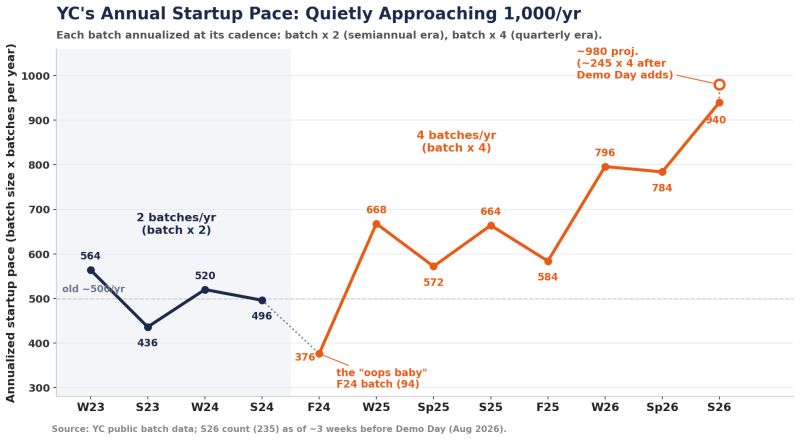
YC quietly doubled - from ~500 startups a year to ~980

When YC moved to quarterly batches, the message was that total volume would hold and each batch would simply be half the size. An investor whose fund backs only YC companies kept the count anyway.

- The series: S24 248, F24 94, W25 167, Sp25 143, S25 166, F25 146, W26 199, Sp26 196
- S26 sits at 235 with three weeks still to run before Demo Day
- Per-batch size is back where it started, except there are now four batches a year instead of two
- At $500K a company that is roughly $500M of YC checks annually

Worth a read if the YC stamp is part of your fundraising story, because the same badge now belongs to twice as many companies. Fair warning on sourcing: this is a YC-focused investor counting his own deal flow, not YC publishing its numbers.

https://www.linkedin.com/posts/jeffheitzman_y-combinator-never-said-theyd-double-annual-activity-7495932666278490112-Cmp9

📎 Read also:
→ Founder Collective scored the 500 biggest exits since 2000
→ 105 YC founders now work at OpenAI or Anthropic
→ Fenwick and Carta - Q1 2026 Venture Beacon on live data

20 last posts shown.