




Postlar filtri


A $1B exit - 8x harder than getting into Harvard

Founder Collective ranked the 500 largest value drivers in venture history and put the odds against a benchmark everyone has an intuition for. Harvard admits roughly 4% of applicants.

- about 0.5% of ~100,000 venture-backed companies over 25 years exit above $1B
- only ~70 companies ever cleared $10B, which is 56x rarer than a Harvard acceptance
- $775M was the cutoff just to make the top 500 list
- IPOs priced six months out, when lockups expire, not at the first-day pop

The harsher half is the fund math underneath: a $1B fund needs a $10B outcome to work, which is the rarest event on this list.

https://foundercollective.com/blog/a-1b-exit-is-8x-harder-than-getting-into-harvard-a-10b-exit-is-56x-harder/

📎 Read also:
92% of US small-business exits are shutdowns
$300B Q1 VC, four companies took 65%
Carta - over 70% of vested options expire


AI unicorns publish almost nothing - someone finally counted

Stanford metascientist John Ioannidis went through every AI company ever valued above $1B and checked what they actually put into the scientific record. It is thinner than the field's reputation suggests.

- 317 AI unicorns from 1998 to 2025 examined, more than half never led a single paper or preprint
- 2,077 publications total where a company researcher was first or last author
- together they account for 1 in every 1,000 AI papers published in 2025

Ioannidis is the person who publicly questioned Theranos in 2015 for the same reason, so treat this as a diligence heuristic: no published record is not proof of fraud, but it is a question worth asking.

https://www.science.org/content/article/ai-s-top-startups-are-barely-publishing-their-research

📎 Read also:
Only 11% of companies run AI agents in production
WEF - the tech winners are integrators
$6T heading into AI infrastructure by 2030


Cloudflare AI Controls - decide which AI bots read your site, and charge them

For any founder whose product IS the content (docs, media, a SaaS with a public knowledge base), the only choice used to be "block all AI or allow all". Cloudflare now splits AI traffic by intent, so you keep search while cutting off free training scrapes.

- Three bot classes - Search (indexing, allowed), Agent (ChatGPT/Claude acting live), Training (model data) - each toggled separately
- "Content Use Signals" in robots.txt - tag content immediate / reference / full to control how bots store and reshare it
- From Sept 15, 2026, new domains block Training + Agent on ad pages by default; multi-purpose crawlers like Googlebot follow the strictest matching rule
- The pay-per-crawl marketplace lets you charge crawlers instead of only blocking them

Strongest when ad or subscription revenue rides on your own content - the intent split finally lets you keep Google while pricing out free training scrapes; niche if your site is a thin app shell with nothing worth crawling.

https://blog.cloudflare.com/content-independence-day-ai-options/

📎 Read also:
The non-branded query that silences founders
Firecrawl /monitor - alerts when docs change
HasData - SERP parsing eats 20-50% of dev time


Pangram scanned 1M+ social posts with its AI detector - and LinkedIn is the epicenter of the slop

Two-thirds of all AI-generated content Pangram flagged across five platforms came from one place: LinkedIn. The professional feed founders lean on for B2B reach is now largely machines talking to machines.

- 62% of all AI-flagged content across 5 platforms came from LinkedIn alone
- On LinkedIn, 40%+ of longform posts flagged as fully AI-generated
- 1 in 4 longform posts (over 250 words) are fully AI across platforms; on X/Twitter only 53% read as fully human
- LinkedIn's own post announcing it would downrank AI content was itself AI-generated

For founders who treat LinkedIn as their main B2B channel, the signal is blunt: the feed is an AI-vs-AI battlefield, and visibly human writing is becoming the real differentiator.

https://www.pangram.com/blog/ai-in-your-feed


San Fran Sim - a startup tycoon game built on real SaaS unit economics

Founders learn unit economics from spreadsheets and blog posts that never punish a bad call. This one does. Free in the browser, no signup: found a startup in a garage and grow MRR to IPO while burn rate, churn and bug outbreaks fight back.

- MRR, churn, LTV and CAC are the actual mechanics - a pricing pivot instantly recalculates your growth curve, not some abstract score
- Shared seed challenges: run the exact same starting parameters as another founder and compare where your decisions diverged
- Free, no signup, one browser tab - "just one more run" pacing

Strongest as a gut-check for unit-economics intuition, not a strategy manual; the $25k starting runway makes the early garage phase too forgiving, so the real pain only shows up once you scale.

https://sanfransim.com/

📎 Read also:
Stripe Billing cannot meter AI tokens in real time
Carta - over 70% of vested options expire
$3T dry powder stuck, DPI just 9%


Deutsche Bank mapped the world's prices for 2026 - and convergence never happened

Globalisation was supposed to flatten prices between cities. Jim Reid has been tracking them for over a decade, and the gap is widening instead, pushed apart by taxes, regulation, currency moves and inflation.

- Tokyo is now astonishingly cheap by developed-market standards, which the authors read as an investment case for Japan
- Tel Aviv became one of the most expensive cities, on a strong shekel plus booming defense and tech
- high salaries in financial hubs get eaten by costs; Zurich and Geneva hold the best balance, Munich and Frankfurt are gaining
- the US looks to be at the peak of its price cycle

Read it if you are choosing where to base a team or route remote hiring; the Japan angle is the sharpest thing in it.

https://www.dbresearch.com/PROD/IE-PROD/PROD0000000000633983.xhtml

📎 Read also:
Saudi population forecast to grow 183% by 2031
Beijing -21.4% on the 2026 startup map
91% of digital nomad visas did not exist before 2020


Yapper Leaderboard - who actually earns reach in the startup conversation on X

Everyone has a sense of who is loud. This ranks founders and operators by how much they post against how much reach it actually earns, which are not the same list.

- sorts the loudest voices in the startup conversation right now
- separates real distribution from people who merely feel omnipresent on your timeline
- free, no signup

Half toy, half distribution map, and most useful if you are building an audience before a raise rather than after it.

https://yappers.context.dev/

📎 Read also:
Newsletters outperform, events beat ads
Product Hunt is one channel, not the channel
Why early startups skip SEO and pay later


OpenSEO - an open-source SEO suite billed by usage, not by subscription

The SEO stack is usually the priciest line in an early-stage budget, and most of that goes to seats you barely use. This covers the same core research and charges for what you actually run.

- keyword research, competitor research, backlinks, rank tracking and technical site audits
- AI visibility monitoring with prompt comparison across models, which the incumbents still charge extra for
- 100% open source and self-hostable; connects over MCP, so a coding agent pulls the data directly

Strongest if you already work through a coding agent, since SEO decisions then come from live data instead of guesses; check the usage rates against your volume before you switch off a flat plan.

https://openseo.so/

📎 Read also:
The non-branded query that silences founders
Repaint - redesign without losing SEO
HasData - SERP parsing eats 20-50% of dev time


ditto - clone any live site into clean, componentized code

Starting from a customer's existing site beats starting from a blank canvas, and this does it without an AI guessing at the markup. A full copy in Next.js or Vite plus TypeScript takes about five minutes.

- a deterministic engine, not a model: same input gives the same output every run, with 96% fidelity and 92% componentization by their own metrics
- extracts design tokens, fonts, hover and focus states, dropdowns, accordions and motion, not just static layout
- MIT licensed, 1.2k stars, free hosted REST API and MCP server, or self-host the whole thing

Strongest for agencies rebuilding client sites fast; the byte-stable output is what makes it a tool rather than a demo.

https://ditto.site/

📎 Read also:
Repaint - redesign without losing SEO
Browse.sh - real browser access for coding agents
zero.xyz - ~8,000 tools with no keys


Founder Collective scored the 500 biggest exits since 2000 - the median is $2.7B

Most unicorn lists are prediction markets: they price what might happen. This one is a scorecard of what did, drawn from ~100,000 venture-backed startups founded since 2000.

- SpaceX tops the list at $2T; the 500th spot is Hippo at $742M
- three companies are worth over $1T, about a dozen over $100B, fewer than 100 over $10B
- roughly 50 of the 500, a full 10%, never crossed a billion at all
- $10T of value realized across the ecosystem in a quarter-century

The uncomfortable part is the fund math: there are corners of venture where owning 20% of a $2.7B exit still does not return the fund.

https://foundercollective.com/blog/unicorn-lists-are-prediction-markets-this-list-is-a-scorecard/

📎 Read also:
92% of US small-business exits are shutdowns
$3T dry powder stuck, DPI just 9%
$300B Q1 VC, four companies took 65%


Supabase asked 2,000 founders what is hard now - technical complexity collapsed

The biggest single shift in the survey: technical complexity as the top challenge fell from 24% to 11% in a year. Free to read, ten chapters.

- customer acquisition now leads at 32%, then product-market fit 14% and fundraising 13%
- burnout appears as a new option and immediately ties technical complexity at 11%
- 61% of startups have more than half their codebase written by AI, and 40% report 76-100%
- solo founders went from 53% to 61% of respondents

When everyone can build, the scarce skill moves to knowing what to build and who to sell it to.

https://supabase.com/state-of-startups

📎 Read also:
WEF - the tech winners are integrators
92% of US small-business exits are shutdowns
Carta - over 70% of vested options expire


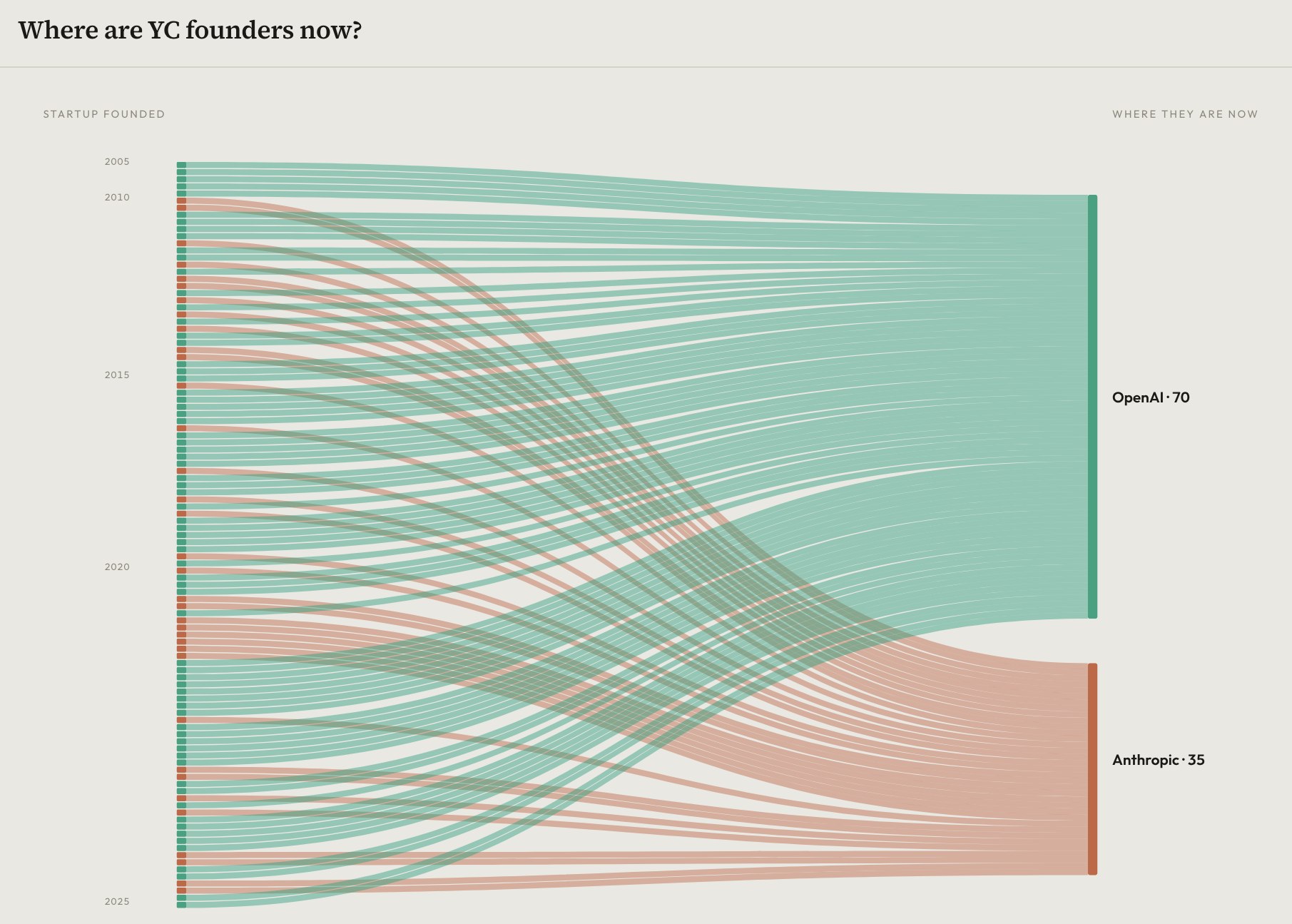
105 YC founders now work at OpenAI or Anthropic - 60% under one title

Startups.RIP tracked every YC founder whose startup was acquired or shut down and who then joined one of the two labs. 70 landed at OpenAI, 35 at Anthropic.

- 63 of them, 60% of all roles, carry the same title: Member of Technical Staff
- sortable table plus a ribbon chart tracing each path from founding year to lab
- free, no signup, built on a base of 1,841 startup post-mortems

The flat title is the story: a generation of CEOs and CTOs absorbed into one job description.

https://joinedanthropic.com/


Exponential View priced real AI demand - $175B, and still 0.42% of GDP

The team modelled 1,000+ firms bottom-up and deduplicated revenue, so the same dollar is not counted again at the app, model and infra layers. 66 pages, free.

- $175B annualized run rate, up from $110B trailing twelve months: 35% QoQ, 3.2x annually
- growing roughly 3x faster than any previous IT wave
- still a rounding error against the economy: 0.42% of US GDP versus 9.4% for the IT sector
- the largest data centers grew 50x in four years

Demand is validated by actual revenue, but the economic footprint is tiny. Big is still small. (PDF, 7.2 MB)

https://intelligence.exponentialview.co/assets/ev-state-of-ai-economy-2026.pdf

📎 Read also:
$6T heading into AI infrastructure by 2030
Beijing -21.4% on the 2026 startup map
$300B Q1 VC, four companies took 65%


Exabase Link Preview - free Open Graph data for 20,000 URLs a month

Anything that renders a link card ends up rebuilding the same scraper: headless browser, proxy rotation, special cases for YouTube and Amazon. This is that scraper behind a single GET request.

- returns title, description, og:image, favicon with dimensions, canonical URL, site name and locale as structured JSON
- renders JavaScript pages on their side, so you run no browser of your own
- 20,000 previews a month free, 60 requests an hour, 0.01 credits each beyond that

The same key also opens Exabase's extract, deep search and storage APIs, which is the actual argument for it over a single-purpose link-preview service.

https://exabase.io/tools/link-preview

📎 Read also:
zero.xyz - ~8,000 tools with no keys
2,000+ API integrations built for agents
HasData - SERP parsing eats 20-50% of dev time


DocsAlot - docs that stay in sync and ship agent-readable

Half your support load is now agents reading last quarter's documentation. DocsAlot spots pages that drifted from the source, drafts the fix and waits for approval before publishing.

- emits llms.txt, skill.md and a hosted MCP server, so buyers get agent access without building the infrastructure
- API docs generated from OpenAPI specs with an interactive playground
- $39/month for startups, $99 for teams, migration from Notion, Intercom or Zendesk included

The real argument is the telemetry: it tracks what humans and agents actually query and recommends what to write next, which no static docs site gives you.

https://docsalot.dev/

📎 Read also:
Zero-touch OAuth for MCP servers is stable
Databox MCP - business metrics inside Claude
Firecrawl /monitor - alerts when docs change


Badge sends AI agents to collect anonymous peer reviews from people you actually worked with, then turns them into a portable Trust Score.

Resumes and LinkedIn profiles now take minutes to generate, so recruiters can't read signal off paper. Badge verifies reviewers by work email, keeps reviews anonymous so they stay honest, and has agents ask targeted follow-ups instead of accepting a generic "great teammate".

A reference check that happens before the interview, not after.

https://getbadge.app/


AnySearch is a search API built for agents, not people: it queries trusted sources in parallel, strips SEO spam and ads, and hands back clean structured JSON.

People skim links and decide what to trust. Agents don't - they build on whatever HTML they get, so stale or messy results mean repeated calls and confident nonsense downstream. Ships as an MCP server, a Skill, or a plain API, with a free tier.

Worth a look if your agent still scrapes raw pages.

https://www.anysearch.com/


Fresh Q1 2026 Venture Beacon from Fenwick and Carta, built on live Carta data.

— AI companies are taking a growing share of all VC
— fewer down rounds, especially at later stages
— valuations trending up across every stage
— fundraising activity still recovering

https://www.fenwick.com/insights/publication/q1-2026-venture-beacon-key-vc-market-trends


QApilot's CoWork turns your existing test cases into running mobile automation and claims 3x the coverage from the same QE team.

It plans and re-plans tests with AI but keeps a human approval step, runs them on real iOS, Android, and Flutter devices, pauses when a decision needs judgment, and fails out loud instead of hiding a broken test.

The "fails transparently, not silently" design is what sets it apart from the usual flaky auto-tester.

https://qapilot.io/product/cowork

20 ta oxirgi post ko‘rsatilgan.